
Engineers are studying ways to monitor power lines for faults and failures to correct those conditions before an outage or fire occurs.
By Katie Satterlee, Texas A&M Engineering | January 16, 2025 | Link to Original Article
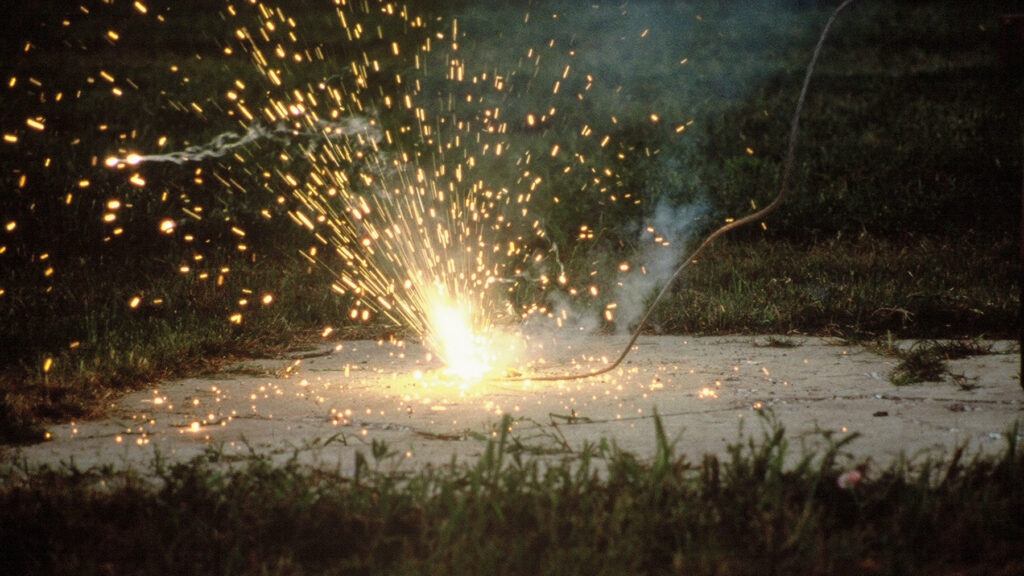
A downed conductor on concrete. Photo provided by Dr. Jeffrey Wischkaemper
Fires can start in 10s of milliseconds, and approximately 10% of wildfires are started by something related to the power system.
For over 30 years, researchers in the Power System Automation Laboratory in the Department of Electrical and Computer Engineering at Texas A&M University have been studying ways to monitor electric power lines for faults and failures to correct those conditions before an outage, fire or catastrophic failure occurs.
In that time, they have conducted several projects to enhance their Distribution Fault Anticipation (DFA) system. The idea is to anticipate a fault before it happens.
Made up of a four-man team that has been conducting research together for decades, Professor B. Don Russell and Principal Research Engineers Carl Benner, Jeffrey Wischkaemper and Karthick Manivannan are working on a nearly $3.2 million Department of Energy (DOE) project titled “Preventing Wildfire Ignition from Powerline Equipment Failures Using ML-Based Classification of Real-Time Electrical Measurements.”
What started as a focus on failure diagnosis of mechanisms on power lines evolved into wildfire and power outage prevention caused by power lines.
“We recognized that a lot of what we were detecting — failures and abnormal conditions out on the power system — were also causing wildfires. And that was just serendipitous. That wasn’t because we set out to do something to fix wildfires,” Russell said.
In combination with growing drought conditions over the last decade, environmental climate change, and changing rain and humidity levels around the country, wildfires have notably grown.
“About 10 years ago, we recognized there was a very substantial increase in the number of wildfires that had been started by electric power lines in the United States,” Russell said.
Since power lines are pervasive in the United States’ geography, a fire could happen anywhere. Most of the vulnerable territories are in rural areas where nobody’s there to observe a fire start and report it.
For one project, the team worked for four years with seven Texas utility companies and received a multi-million-dollar grant from the state of Texas to study the impact of power lines on wildfire ignition and what could be done to prevent fires.
During this project, the team developed techniques that could find and allow companies to fix mechanisms that start wildfires. The main causes of wildfires are weather and human actions, such as dry lightning, an unattended barbecue pit, or burning trash. Each year, up to 10% of fires are started by power lines.
How Do Fires Get Started From Power Lines?
Power line conductors in the air can move around substantially in high wind conditions, and if they hit each other—called a conductor clash—they throw off incandescent metal particles that are ignition mechanisms.
Fires can also start from equipment failure. This can occur if a transformer explodes or a pole falls over and lines end up on the ground, or a connector, the device holding the power lines together, overheats and drops melted metal.
The single largest issue is when power lines break in the air, fall to earth and arc to the ground. Arcing conditions sometimes only last for half a second, but it doesn’t take long to start a fire. To make matters worse, sometimes these ground fault conditions are not easily detectable.
The team is examining how conditions in the air affect power lines to prevent them from falling. The team’s algorithms can detect small arcing conditions and failures from miles away. Their DFA system can give utilities up to weeks’ notice of a problem long before catastrophic failure.
“If we can find the issue and tell utilities it’s happening today, they can find and fix it by tomorrow,” Russell said. “We’ve been able to predict the location of power line equipment failure, which left alone for two weeks could have etched through the conductor and dropped lines to the ground. But we identified the problem weeks in advance and were able to prevent disaster.”
For example, MidSouth Electric Cooperative, a utility company in Navasota, tested DFA and uses it daily. In one instance, a clamp started arcing in the Sam Houston National Forest, which could easily start a fire. The DFA system identified the issue and notified the utility company. They were able to repair the clamp and prevent an outage or a fire.
Using AI And Machine Learning
Currently, the team is using conventional algorithms and computer science programming to conduct research. However, their DOE project will look at expanding that technology through artificial intelligence and machine learning to improve DFA sensitivity and reliability for early detection of failures.
“When the Department of Energy asked for projects under the Office of Cybersecurity, Energy Security and Emergency Response program, we proposed to take all the work we had done over the past 30 years as the foundation and build on that to look for substantial improvements using machine learning and artificial intelligence,” Russell said.
“We’ve been able to detect many failure mechanisms for 15 years, and we’re getting better and better at it, but machine learning carries some distinct possibilities for the future,” Russell added “Hopefully, it will result in even better diagnostic tools to find those things that cause not only wildfires, but also outages for customers.”
The future project also has international scope. The team currently has test systems in Australia, New Zealand, Scotland and England, as well as the United States. Australia and New Zealand have a high risk for wildfire issues, and England and Scotland’s concern is primarily improving reliability.
“This is a tool, not just for wildfire mitigation, but to significantly improve the reliability of service. It would benefit everybody that uses it, even if they’re not in a wildfire-prone area,” Russell said.

